

Artes Mechanicae is a research group engaged in the study of the history of science and technology, characterized by an interdisciplinary approach that integrates traditional historiographic methods with analytical tools, classification and visualization borrowed from engineering and information technology.
The activity of ArtesMechanicae is directed by an international scientific committee composed of specialists from various historical-humanistic and scientific-engineering disciplines, who continually promote research results in congresses and workshops.
ArtesMechanicae promotes technical-scientific culture through the design and realization of exhibitions, providing museographic consultancy, performing restorations, creating editorial products, models of scientific machines and instruments reconstructed with philological fidelity.

Founder of ArtesMechanicae
Andrea Bernardoni
Andrea Bernardoni he obtained a doctorate in History of Science at the University of Florence and for years has been dealing with the history of technology at the Institute of the History of Science (Galileo museum). He was curator of sections in important exhibitions dedicated to Leonardo da Vinci such as: Leonardo, water and the Renaissance(Milano 2004), The mind of Leonardo(Florence 2006, Such 2007, Debrecen 2007, Saint Joseph (USA) 2008, Roma 2009), Leonardo and the art of Sculptor (Atlanta 2009, The Angels 2010); The Mechanical Dreams of Leonardo da Vinci(Rombas 2008); Leonardo da Vinci and France (Amboise 2009); Leonardo DeVinci, “Romorantin, the forgotten project” (Romorontin 2010); Explosions fusions transmutations. The monument to Francesco Sforza and the chemical arts in Leonardo (Milano 2013). Winner of the first prize for the scientific documentaries section at the film festival "Seeing science" (Milan-London, 2007) with the 3D animation movieThe colossus of Leonardo. In 2010 designed and coordinated for the Institute of the History of Science in Florence the numerical simulation of the fusion of the "Monument to Francesco Sforza" designed and not executed by Leonardo. He is the author of numerous publications on the history of Renaissance science and technology.

Founder of ArtesMechanicae
Alexander Neuwahl
Alexander Neuwahl is a professional in the field of design and communication; from 1996 works with the Leonardo Museum of Vinci for the creation of scientific and historical dissemination material and from 2002 for the design of installations and creation of multimedia itineraries, managing and coordinating teams of creatives to support the process of radical innovation and evolution still underway today.
Since then he has continuously designed and contributed to the creation of exhibitions and sections of Leonardo-related exhibitions at a national and international level: The Atlantic Codex of Leonardo da Vinci in the Hoepli edition 1894-1904 (Roma 2005); Leonardo da Vinci, Heinrich Schickhardt. and the technology of their time (Stuttgart 2008); The Mechanical Dreams of Leonardo da Vinci (Rombas 2008); Leonardo da Vinci and France (Amboise 2009); Leonardo the architect. From drawing to machines (Verona 2010); Leonardo DeVinci, “Romorantin, the forgotten project” (Romorontin 2010).
In the context of many international conferences he has been and is an active promoter of the use of three-dimensional reconstruction techniques as a historical-scientific research tool.

Scientific Committee of ArtesMechanicae
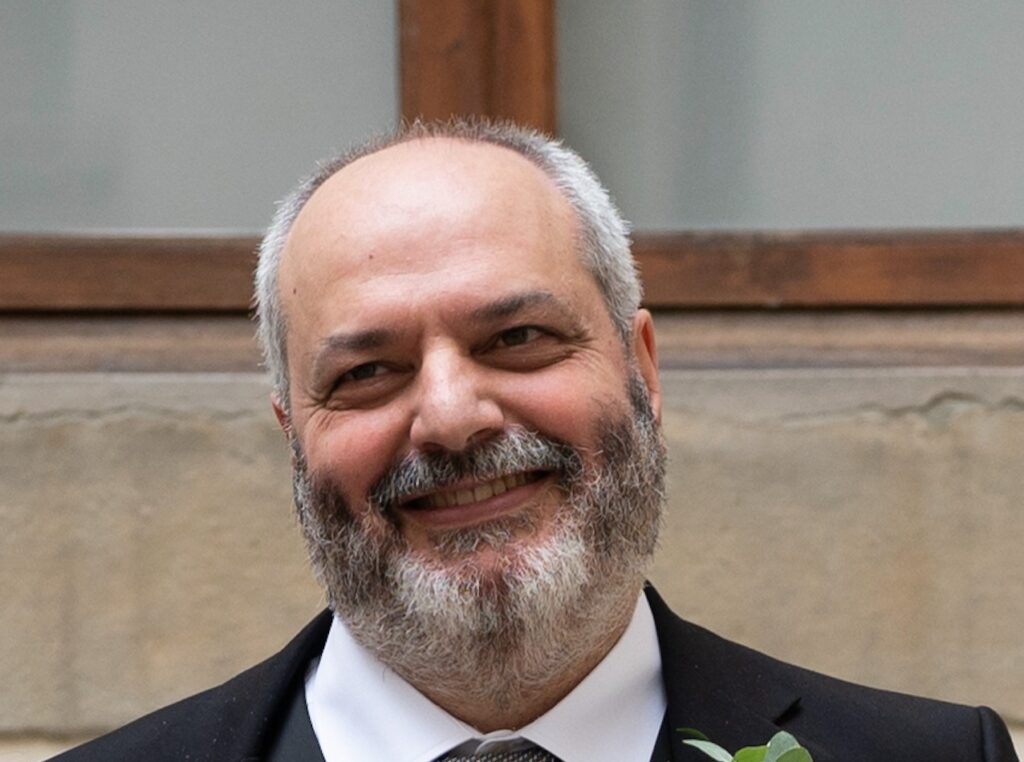
Giovanni Bianchini
Giovanni Bianchini is a researcher at the Institute of Applied Physics “In Carrara” of the National Research Council, where he carries out experimental activities in the field of optical devices and instrumentation, in particular in the field of Fourier transform spectrometers (FTS). In this context, in addition to the development and characterization of the instrumentation through laboratory measurements, participated in numerous measurement campaigns in which the aforementioned instrumentation was installed and operated in order to characterize the chemical and radiative properties of the earth's atmosphere, campaigns that took place in the Arctic and Antarctic regions, in high altitude sites, in tropical regions. Alongside the main business, Giovanni Bianchini carries out activities in further research fields, always in the context of optics, such as high precision laser spectroscopy, laser interferometry for metrological applications and development of laser sources.
From 2002 collaborates with the Leonardo Museum of Vinci, both as a consultant and as part of a research agreement between CNR and the Municipality of Vinci, as a contact person for problems concerning physics (optics, mechanics, fluid dynamics and more).
Scientific Committee of ArtesMechanicae
Marco Biffi
Marco Biffi he graduated in History of the Italian language at the University of Florence and specialized in Art History at the Scuola Normale Superiore in Pisa. He is professor of Italian Linguistics at the University of Florence and academic correspondent of the Accademia della Crusca.
His research activity is mainly focused on the study of technical language in diachrony (in particular the architectural and more generally artistic one, and that of machines), of the transmitted Italian (radio, television, telephone, network language), of computer linguistics applied to the history of language. He also dealt with sixteenth-century cookbooks and military language, and more generally of linguistic strategies for communication, of phonology (even in diachrony), of lexicography. To the study of themes is added the analysis of the language of specific authors, including: Boccaccio, Leon Battista Alberti, Francesco di Giorgio Martini, Leonardo da Vinci, Peter Cataneus, Benedict Varchi, Cosimo Bartoli, Andrea Palladio, Galileo Galilei.
With Paola Manni he directs the Leonardian glossary of the portal e-Voice. Digital archive of the history of technology and science https://www.leonardodigitale.com/. He directed the project of the Crusca lexicography on the net (www.lessicografia.it), i.e. the electronic version of the five editions of the Vocabulary of the Academics of the Crusca, online since 2005.
Among his publications are noted: Francesco di Giorgio Martini, The translation of the On Architecture of Vitruvius (dal ms. II.I.141 of the National Central Library of Florence), edited by Marco Biffi, Pisa, Scuola Normale Superiore, 2002; Leonardian glossary. Nomenclature of machines in the Madrid and Atlantic codes, edited by Paola Manni and Marco Biffi, Florence, Olschki, 2011, M. Biffi, Linguistic engineering between Francesco di Giorgio and Leonardo, LIII Vincentian reading, Florence, Arrived, 2017; M. Biffi, The "failure of words". Observations on Leonardo's language, Florence, Franco Cesati Publisher, 2021.
The complete list of publications can be consulted at www.marcobiffi.it

Scientific Committee of ArtesMechanicae
Pascal Brioist
Pascal Brioist he is Professor of Modern History at the Center for Higher Renaissance Studies of the University of Tours. Consultant for the scientific initiatives of the theme park dedicated to Leonardo, Clos Lucé (Amboise), has been “Exhibition Curator” for exhibitions: The mechanical dreams of Leonardo da Vinci, (Rombas 2008) eRomorantin: Leonardo da Vinci's forgotten project (Romorantin, 2010). His main publications are: Cross swords: violence and fencing culture from the 16th to the 18th century(Champvallon, 2002); The Renaissance, 1450-1570 (Atlantic, Neuilly, 2003); Harriot, reader of Alvarus Thomas and Niccolo Tartaglia, inMathematics and Theory of Motion, 14th-16th centuries (University Press of the Septentrion, 2008); Familiar demonstrations in geometry : French and Italian engineers and Euclid in the sixteenth centuryin “History of Science” (2009). He is also the author of several articles on Leonardo da Vinci: "Léonard's French pipeline projects" e "Léonard et le palais de Romorantin" inLeonard and France (CB Editions 2010); The dissemination of Know-How: the case of the Bell La Mutte in the City of Metz, inLeonardo da Vinci and Heinrich Schlickhardt (Verlag W. Kohlhammer, Stuttgart, 2010). In 2010 has made aPhotographic documentation file on Leonardo da Vinci.

Scientific Committee of ArtesMechanicae
Océane Fontaine Cioffi
Océane Fontaine Cioffi is a doctoral student in History at the Center for Higher Studies on the Renaissance (University of Tours). His thesis focuses on the art of perfumes in 16th century France and examines the knowledge and skills related to the production of fragrances, focusing on industry professionals, on the proceedings, on the materials and social and cultural uses of odors.
His research lies at the crossroads between the history of science and technology, the history of the senses and experimental history. In this context, he uses reconstructions of historical fragrances to try to capture the gestures, the tacit knowledge and sensory experiences of the artisans.
His works have given rise to reports at international conferences and reconstruction workshops. He contributed to the exhibition Leonardo da Vinci and perfumes during the Renaissance (Amboise, 2024) as assistant to the curator Pascal Brioist, reconstructing various fragrances and taking care of the «Perfumes at the court of Francis I» room, theme to which he dedicated an article in the exhibition catalogue.
Recognized as an expert on Renaissance perfumes and olfactory knowledge, contributes to their study by paying particular attention to material dimensions, sensorial and embodied practices.

Scientific Committee of ArtesMechanicae
Fanny Kieffer
Fanny Kieffer she is an art historian, of Renaissance philosophy and literature, deals with Italian Renaissance art, history of the collections, history of art institutions, literature and science in Italy and France from the 1400s to the 1700s, as well as the history of science and technology from the 1400s to the 1700s. He has held teaching positions in the field of art history at the François Rabelais University in Tours, and has been involved in research commissioned by various European institutions such as the La Sapienza University of Rome, the Cini Foundation of Venice or the Warburg Institute of London.
He has also carried out organization assignments for exhibitions and training events. She worked as a translator and interpreter.
Over the years he has carried out extensive research work on the complex of the Uffizi shops in 16th century Florence, whose publication constitutes the work of his doctrate thesis.

Scientific Committee of ArtesMechanicae
Davide Russo
Davide Russo he is a researcher in the industrial engineering department of the University of Bergamo and a professor of methods and tools for product and process innovation, and industrial design. He graduated from the University of Florence in "design and construction of machines" with the thesis "From the multidisciplinary nature of the Renaissance engineers to the management of complexity in the processes of innovation and technological forecasting.”
In addition to applications in the industrial field, contributions and collaborations in the field of the history of technical science are added, among which:
– The collaboration with the Leonardo museum of Vinci for the definition of the contents of the museum rooms dedicated to construction machinery and Renaissance textile machines, “Evolutionary Triz models as a support tool for researchers in the history of science and technology. The construction site of S. Maria del Fiore (thesis)”;
– collaboration in the creation of the Leonardo Digitale website http://www.leonardodigitale.com
From 2007 is scientific collaborator of the project for the realization of the first volume of the "Leonardian Glossary. Machine nomenclature of Madrid and Atlantic, edited by Paola Manni and Marco Biffi (Florence, Olschki, 2011).
It has developed an innovative method to support the studies of history of science and technology researchers based on the evolutionary classification of machines with the TRIz methodology

Scientific Committee of ArtesMechanicae
Giorgio Strano
Giorgio Strano he is curator of the collections at the Institute and Museum of the History of Science in Florence, carries out research and dissemination activities in the field of the history of astronomy.
He has published several articles in Italian and foreign specialized magazines: Mandatory, Astronomy,The History of Astronomy, The New Bibliographic Information, Automata, Journal of Astronomy, Stars and space.
He has collaborated in the creation of exhibitions on the history of science and astronomy: Scientists at Court (2001), A thousand years of science in Italy (2001), The myth of Europe (2002), Glass (2004),World Machine (2004), Relativity from Galileo to Einstein (2005), Galileo's Telescope (2008-2009). He is general editor of the seriesScientific Instrument and Collections, edited by Brill.

ArtesMechanicae laboratory
Sofia Basilissi
Sofia Basilissi, fiorentina, she has a degree in architecture, model maker, he is also involved in museum education.
After training at the Istituto d'Arte in Florence, he combines his university career with collaborations with architectural studios, art collections, museums and artists for the creation of models and maquettes.
In 2014 crea PlasticiSB, the laboratory workshop in which he designs, builds and restores models, where materials and models are invented for museum teaching and processes are experimented, tools and materials.
Some of his models are exhibited at the Museo dell'Opera in Florence, in the Gori Collection of Pistoia, in Santa Reparata in Florence.
Others have passed through the halls of the IVAM in Valencia, the Venice Biennale, the Officine Grandi Riparazioni of Turin, the Maeght di Saint Paul de Vence Foundation.
From 2016 collaborate with ArtesMechanicae for the production of wooden products, reproduction of Leonardo's machines, restoration interventions on models and educational workshops

ArtesMechanicae laboratory
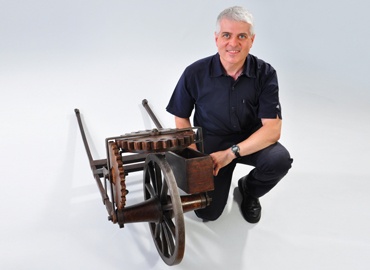
Michel Campana
Michael Camapana he is a professor of mechanics at the Technical High School of Poitiers and has taught automotive mechanics and the production of mechanical parts for industry in various institutes. During his teaching activities he studied and reproduced clockwork systems and gear trains, specializing in the construction and restoration of monumental clocks using techniques similar to those used for metalworking in the 15th century. In January 2013 participated in a conference on time measurement at the CESR in Tours, where he presented the reconstruction of the monumental wrought iron astronomical clock currently in operation in Chinon.
For some time he has dedicated himself to the study of Leonardo's mechanics, going so far as to reconstruct a model of the mechanical lion currently on display at the Clos Lucé in Amboise. He also made replicas of scientific and measuring instruments, exhibited at the exhibition “An idea, mille machines – From Leonardo da Vinci to Jean Errard” (Nancy 2013) and presented at the international conference “Leonardo da Vinci. Peace art, art of war” (Florence, 2013).
ArtesMechanicae laboratory
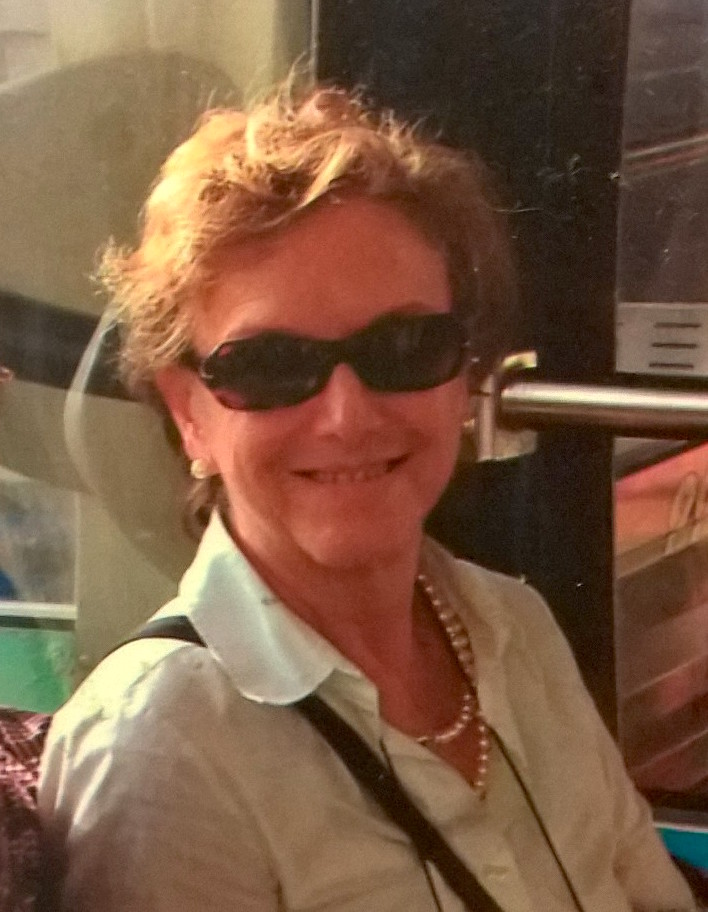
Jean-Louis Pironio
Jean-Louis Pironio works in the field of information and communication. He is also an expert photographer. Together with his father Jean-Pierre, from 2008 has participated in various projects and exhibitions whichArtesMechanichae contributed. In 2008 he was part of the organizing committee of the exhibitionMechanical Dreams of Leonardo da Vinci (Rombas – France), while in 2010 coordinated the creation of the scale model 1:2 of the anti-friction mechanism of the monumental bell “La Mutte” (Metz Cathedral – France) exhibited in the Leonardo Museum of Vinci. Always in 2010 built some mechanical apparatus designed by Leonardo da Vinci for the exhibition “Romorantin, the forgotten project” (Romorantin – France). As part of the exhibition “An idea, 1000 machines- From Leonardo da Vinci to Jean Errard" of 2013 (Nancy – France) he was the author of the first ever reconstructions of some machines designed by Jean Errard de Bar-Le-Duc, 16th century engineer and fortification designer. He is the author of the reconstruction of a working example of an odometer designed by Leonardo da Vinci (Codex Atlanticus f. 1r) which was exhibited at the Louvre Museum in Paris in September 2015. Among his latest creations: an educational printing press on the principle of that of Johannes Gutenberg and, taken from Leonado's drawings, a mechanical lung, a webbed glove and a flapping wing for exhibitions “Take inspiration from the living” (Romorantin, 2019) e “Leonardo and the new arts” (Palmanova, 2019-20).
ArtesMechanicae laboratory
Iliana Toti Manetti
Iliana Toti Manetti is a stylist and model maker at Manetti Italia.
He has collaborated in the design and creation of costumes for important theatrical productions such asChristmas at Casa Cupiello eAH (for the theater company “Stabile Mobile” by Antonio Latella; Re Lear (directed by Michele Placido / Francesco Manetti), The bourgeois gentleman (directed by Francesco Manetti / Simone Martini).
From 2014 collaborate with ArtesMechanicae as an expert in tailoring techniques for creations that involve the use of fabric and leather.
A constant commitment made of personal motivations

